In the highly competitive and profitable world of professional sports, stadium building has become an arms race. With lucrative sponsorships and naming deals on the table, and the potential jackpot of hosting an event like the Super Bowl, sports teams are scrambling for the biggest buildings, the largest screens, the flashiest private suites, and the most tech-forward fan experiences.
But newer isn’t always better. For a growing number of professional sports teams and stadium operators, it’s starting to make a lot more sense to renovate their existing buildings instead of building new ones. Often, they’re getting more out of an old building than they could have from a new one.
[Rendering: courtesy HOK]
The NFL’s Jacksonville Jaguars is one team currently in the midst of a major stadium renovation project. Located on the edge of downtown on a site both the team and the city felt was too good to lose, the 31-year-old EverBank Stadium is now under construction in a $1.4 billion renovation that will refresh the building for a full reopening in 2028.
Jaguars president Mark Lamping says the project has all the economic and sustainability benefits of not having to build a project from scratch, but dollar-for-dollar, it also gives back more than a new stadium could. “You utilize existing infrastructure. So you’re not going back and redoing utilities and big costs related to traffic and transit and parking and all those things that are not necessarily viewed as value added to the customer,” he says. “We’re investing, you know, $1.4 billion, but a greater percentage of that $1.4 billion is going into fan-facing elements.”
[Rendering: courtesy HOK]
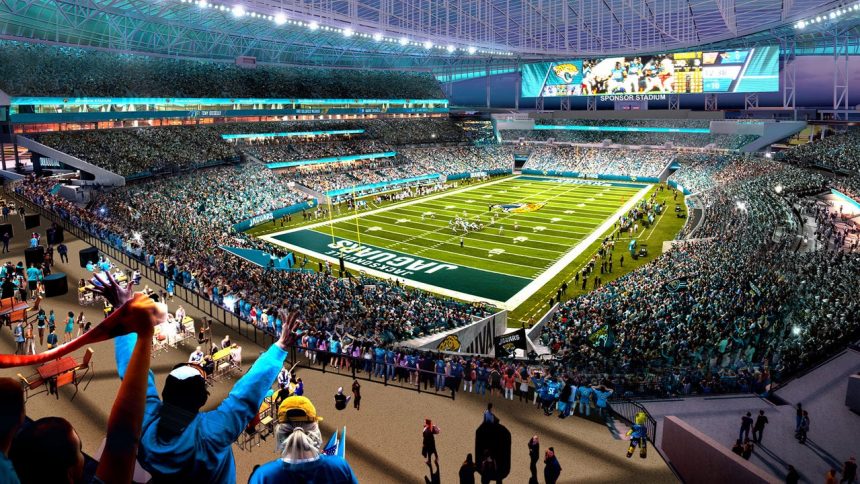
Designed by the architecture firm HOK, the project has been dubbed the Stadium of the Future, and it re-sculpts the old stadium into a curvaceous and modern facility, with wider concourses, a transparent roof canopy, more seating options, and 11 club environments.
“Fundamentally it’s an ROI discussion,” says Peter Broeder, design principal of HOK’s Kansas City studio. “Because the bones of that building were in good shape, it became about deploying capital in a way that would yield maximum value for all parties.”
A new-ish design
Compared to the conventional open-air bowl it’s replacing, the new stadium is a space-age capsule wrapped in a mirrored facade. It’s essentially a new shell wrapping around the steel and concrete bones of the stadium, all of which are still in good enough shape to stand for decades.
“[Team owner Shad Khan] was really interested in trying to do something that made a pretty significant architectural statement for downtown Jacksonville,” Lamping says. “We clearly wanted it to be a significant departure from what our existing stadium looks like. It’s not the same stadium with some improvements here or there. We wanted people, when they looked at it, to see and feel something that was totally different than what they had experienced in the past.”
[Rendering: courtesy HOK]
The new stadium also solves some of the problems that have bothered the team and its fans since the 1990s. The biggest issue: punishingly hot seats in the Florida summer sun. “It is incredibly hot inside the stadium, particularly on the east side of the stadium during the early parts of the season. So any solution that we were going to come up with had to deliver shade on all the seats,” Lamping says.
HOK’s solution is a roof canopy that covers most of the seats, combined with a unique transparent roof structure that shields fans and players from rain. Designed to take advantage of the prevailing winds, the stadium directs them through four large corner breezeways into the concourses and down onto the seating bowl, passively cooling the space and eliminating the need for air conditioning.
[Rendering: courtesy HOK]
The concourses themselves are also an important part of the design, increasing the flow of air but also the comfort of fans. Lamping says the concourses now wrap around the entire stadium, and are up to five times as wide as what was previously there.
The renovation was primarily designed to improve the fan experience, but it’s also aiming to increase the stadium’s ability to host different kinds of events. To make sure the space could handle a wide range of events, Lamping says the team consulted concert promoters, national governing bodies that might be bringing events to Jacksonville, and representatives at the University of Florida and University of Georgia that use the stadium for college sports. The idea was for the stadium to be capable of hosting anything from a concert to an international soccer match to a Super Bowl.
“The nature of live sports and events has evolved significantly over the last 30 years. Venues today need to be far more multi-purpose in nature,” says Broeder.
That’s directly connected to the bottom line. A stadium that can be used for more things is used more often, bringing in more revenue. “We want this to be sustainable not only in terms of its construction, but also in terms of its ongoing functionality and in terms of the impact that it has on the community,” says Lamping. “One of the best ways to do that is to have it be busy.”
Location is key to this multi-functionality, which is part of the calculation teams are using to determine whether to build new or to renovate. Like the Jaguars, the Carolina Panthers NFL team in Charlotte decided to renovate its downtown-adjacent stadium.
“That building was a bit of a greenfield site when it was initially built. And then over time, the city has sort of grown to it and it’s right on its doorstep,” says Nate Appleman, a director of HOK’s global sports, recreation, and entertainment practice, which is designing the project. “It didn’t make sense for them to go away from what they have, which is a really great site with a real good set of bones to build from.”
[Rendering: courtesy HOK]
Another benefit of renovation is that teams and stadium operators already understand where improvements are needed. “They know what’s working in their building and they know where their gaps are,” Appleman says. “When you’re starting out with a new building, all of that is very nebulous at the beginning.”
That doesn’t mean the stadium renovation process will be easy. In Jacksonville, for example, construction started in 2025 and will continue through 2028, which means the team will play the 2026 season in a half-deconstructed stadium with reduced capacity and the 2027 season more than 100 miles away in Orlando.
“We knew going in we were going to have some headaches,” says Lamping. “All that makes it a more difficult proposition. But if we would have built a similar stadium on a greenfield site someplace else in Northeast Florida, the cost would have been at least $1 billion more. So we think we’re getting a good value.”