The glowing sun sets into the shimmering ocean, signaling that it’s time to rest from another balmy day in West Hawaii. But sleep isn’t on the horizon for the Aha Pule ‘Āina Holo runners—as a team, they still have 27 miles to go before they reach Puʻukoholā Heiau in Kawaihae, where they will eat dinner and try to get some rest before the final day.
This could be a scene at any number of ultrarunning relay events across the globe, but other details feel less familiar: The enthusiastic runners wear white headbands, proudly carrying the “Lono,” a wooden staff mounted with a small, carved head, as vehicles driving past honk, cheer, and even get out to wish them well.
For indigenous runners from California to Hawaii and Japan, the motivation behind ceremonial relays known as prayer runs is much deeper than beating another team, covering a new distance, or breaking an arbitrary record.
In many cases, these events are open to anyone ready to embrace running in a cultural and spiritual way, and unsurprisingly, the collective effort of prayer running is growing into a global movement—one rooted in practices that predate modern ultrarunning (by a long shot).
What Is Traditional Prayer Running?
For millennia, running has been part of Native American culture, though individual people groups have had subtly different intentions behind it.
The Tarahumara Indians—famously portrayed in modern mainstream culture by Christopher McDougall’s bestselling book, Born to Run—have practiced a form of ultrarunning as a spiritual practice that unites them with nature and each other.
For the Hopi, Navajo, and other tribes, long-distance running has been used for ceremonial purposes: By focusing on a specific intention throughout runs that ranged from an all-day jaunt to a 100-mile journey, these moving meditations became the foundation for prayer running.
For the Pit River Nation, the impact of running was similarly never measured in fitness or pace, but as a way to connect to and show gratitude for the land and the ancestors who have run on it for centuries—specifically in the “100-mile square” area of Northern California, which is home to Mount Shasta. To this day, Pit River members practice traditional rituals at sacred places along the 14,162-foot mountain’s slopes and within its forests.
Prayer running tradition itself has also traveled thousands of miles across the ocean: according to some ancestral accounts, Native Hawaiians once traveled by canoe to California and visited the Mount Shasta region.
Off the North American mainland, it’s well documented that Hawaii’s aliʻi (chiefs) and kahuna (priests) similarly traversed the island of Hawaii clockwise to herald “Makahiki”—the season of gratitude, sport, and reflection. On their journey, they carried a staff with the image of Lono, the god of farming, thunder, and sports.
Ancient Hawaii was also known for its kūkini—highly-trained runners who underwent demanding training that would condition them to deliver critical messages to aliʻi, summon warriors, and gather intelligence. Some tradition states that foot races among the kūkini elicited spectators to bet on their favorite runner.
Even further across the Pacific Ocean, Japan was known for its own hikyaku, which translates to “flying feet” in the 17th-19th centuries. Though less of a prayer tradition, the military government and civilian merchants relied on these runners to practically carry items and messages throughout mountainous terrain at unfathomable speeds.
Hikyaku ran in teams of two, ensuring that if one was injured, the other could continue moving forward with the delivery in a box, attached to the end of a bamboo pole. For over 300 years, hikyaku ran relay style, passing off the parcel or message to the next runners and covering nearly 125 miles every 24 hours.
Before (and after) hikyaku hit the scene, many Buddhist monks of Mount Heie in Japan faced the Kaihōgyō—a seven-year quest dating back to 1585 that involves a 23,000-mile prayer walk.
The Aha Pule ‘Āina Holo
“The inspiration for Japan’s Tasuki Run and Hawaii’s ʻAha Pule ʻĀina Holo is the Pit River Ancestral Run,” says Lanakila Mangauil, a Native Hawaiian cultural practitioner and founder of prayer run ʻAha Pule ʻĀina Holo.
In 1992, Pit River cultural advisor Radley Davis and other community members launched the Pit River Ancestral Run to restore community well-being and reclaim the identity of the Pit River Nation while addressing health and social challenges. Native American prayer sticks adorned with bird feathers are passed from runner to runner, reflecting a belief that running on the land in a prayerful way connects them to their ancestors, the world, and all of creation.
Generally held at the end of July and spanning from 130 to 160 miles, the prayer run has begun at Little Medicine Lake, heading to Elk Flat then Burney, and on to Lassen Volcanic National Park, where runners finish with a fireside ceremony.
For years, runners from Hawaii have participated in the annual run, and in turn, Pit River runners have participated in the Aha Pule ‘Āina Holo, which Mangauil founded in 2013.
The start of the Lā Holo run. Runners carry the Lono through Laupāhoehoe to the Kamehameha statue in Hilo. (Photo: Courtesy of Hōʻā Hawaiʻi)
Held in the middle of November, Aha Pule ‘Āina Holo relies on two to 20 runners to carry the Lono staff to designated points where they pass it to the next group of runners. In each district of the Island of Hawaii, a coordinator organizes the runners, facilitating the handoff of the staff, and arranging for food and lodging.
“‘Aha Pule ʻĀina’ means prayer for the land, and ‘Holo’ means moving. This four-day run honors the ancient practice of traversing the island while standing as a new ceremony for those who want to share the medicine of prayer running.”
In ancient Hawaii, the Ala Kahakai and other rugged trails were likely used by aliʻi carrying the Lono staff. For the Aha Pule ‘Āina Holo, Mangauil chose to use highways and paved roads: “It’s safer, and it’s more inclusive to runners of all ages and abilities. Being on the main roads also means that we can interact with more people. Drivers often pull over to ask us what we’re running for, and this sparks important conversations.”
(Photo: Courtesy of Hōʻā Hawaiʻi)
“Running Is a Prayer in Motion”
The prayer run begins with a gathering of Hawaiian practitioners at Mauna Kea’s summit. Considered the residence of snow goddess Poliahu, as well as the first-born child of the sky father and earth mother, Mauna Kea is sacred as the birthplace of the Hawaiian race. The actual 294-mile run itself then begins 60 miles away (by road) in Honokaʻa before continuing to the world’s most active volcano, Kīlauea.
After some sleep, runners take the Lono to Pāhala, Nāʻālehu, and Miloliʻi on day two. On day three, this “run” takes an off-road turn: The Lono staff is sent on a waʻa (canoe), much like the one that reputedly traveled to California, through Hōnaunau to Kealakekua Bay, where paddlers swim the staff ashore.
(Photo: Courtesy of Hōʻā Hawaiʻi)
The run then continues on to Kona and Hāpuna, concluding at Puʻukoholā Heiau. On the final day, runners take the Lono to the King Kamehameha statue in Kapaʻau before continuing over Kohala Mountain Road to Waimea, where runners head down Mud Lane to Kukuihaele before finishing back where they began in Honokaʻa Park.
“Mud Lane was the longest stretch. There’s no support there. It took 20 of us about one and a half hours to run all 6 miles. Even if you’re feeling good, you don’t leave the other runners. You run together because you pray together,” says Chase Silva, who ran about 40 miles of the prayer run over four days.
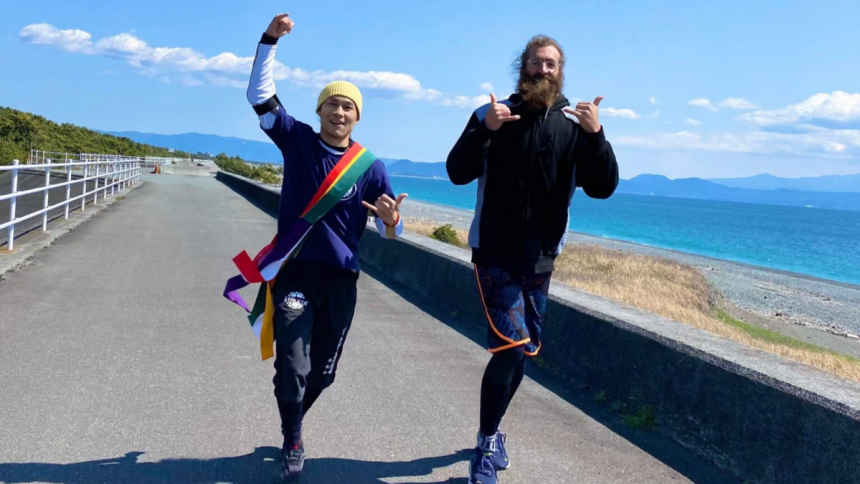
Similarly, Japan’s Tasuki Run promotes unity over individual accolades. Since 2017, the three-day prayer run has been held in March or April, taking participants around Mount Fuji. While ‘Tasuki’ is the cord that is used to tie up a kimono, it also symbolizes the partnership it takes to accomplish great feats.
In the Tasuki Run, a five-color cord is used to symbolize a story about five colors of people that came together in ancient Japan to pray. And it’s a sash rather than a prayer stick or staff that is passed from runner to runner. As runners move through the sacred grounds of Futaoka and Fujisan Hongu Sengen Taisha Shrines, and around Lake Saiko Nemba-hama, the prayers for peace and gratitude that are embedded in the sash are passed along in a relay format.
Like the ancient hikyaku who ran in pairs, two people usually run at a time while the other runners follow along in their vehicles, jumping out to cheer or take their turn until the Tasuki Run finishes with a potluck at Gotemba Kannoji Temple.
“Running makes you sweat, and
that sweat soaks into the earth and
becomes part of the earth’s circulation.
Running is a prayer in motion.
It heals the earth and connects you to yourself”
– Tasuki Run participant
This same spirit pervades the Aha Pule ‘Āina Holo relay.
“All are welcome to the run. Just wear a white headband, which represents the clouds and connection with the elements. It also represents the sweat from our physical sacrifice of running hard for something bigger,” Mangauil says. “If we can move a small staff over 200 miles, across different landscapes and ecosystems, what else can we do when we come together as runners? We can protect sacred sites, our watersheds, our oceans, and our land when we, as people from many different backgrounds, pray and move together.”
How To Get Involved
Ready to come together with other runners and discover a deeper side of ultra races? Here are five prayer runs to check out:
The Sacred Mountain Prayer Run (Flagstaff, Arizona) is held every June and open to everyone who registers.
The Tasuki Run (Fujinomiya City, Shizuoka Prefecture, Japan) is typically held every March and open to applicants. Email [email protected] for more information.
The ʻAha Pule ʻĀina Holo ceremonial run (Honoka’a, Hawaii) is held in mid-November and is open to everyone. Email [email protected] for more information.
The California American Indian Spiritual Marathon Relay (San Francisco, California) is typically held in June and anyone can run, but they must first establish sponsorship.
The Rising Hearts Indigenous Peoples Day Run (Virtual) is held around Indigenous Peoples Day in October. Registration is required.